
My training progress
21 km
My target
100 km
Why I'm running
I'm running this October to save lives and help more Australians access essential healthcare.
Donate now >>I'm fundraising for the Royal Flying Doctor Service
ruining Christmas for my entire family and quite a few of my friends. I had a subarachnoid haemorrhage due to a ruptured aneurysm. The odds of surviving this type of medical emergency aren’t great. The odds of survival with no lasting disability are also pretty grim. (Skip ahead now to the last paragraph if you don’t want to hear how I did all the wrong things, and only survived out of sheer luck. Unfortunately, I can still see the silent, slightly disappointed stares of the many medically trained people in my life, and they still make me wince in embarrassment.) An avid historian with negligible medical knowledge, I did not improve my odds by seeking medical advice immediately (at the time I was literally doing bootcamp with a doctor). Instead I told myself this sudden nausea inducing headache was probably a migraine (no I’ve never had a history of migraines, yes you can roll your eyes at me), I took a bunch of aspirin and went to work. (Aspirin, a blood thinner whilst haemorrhaging. I did say I did all the wrong things.) My work colleagues sent me home, which I did, on my own, and slept all day (another wrong thing). Over 24 hours later (wrong thing) when I had most definitely not improved and at the insistence of my wife, I drove (wrong again) to see a GP who insisted I call Roz to take me to Busselton Hospital. From there things moved very quickly. CT scans clearly showed the bleed, I learned the term subarachnoid haemorrhage and before I knew it a doctor was telling me that an RFDS plane had been diverted from Esperance and that I would be on it shortly.
According to a paramedic I know (my sister) best practise is for a patient to receive specialist medical care within 4 hours of first contact. The RFDS played a decent role in ensuring that I was on a ward in HDU at Sir Charles Gardiner Hospital under the care of an excellent neurology team within four hours of first presenting to my GP.
Imagine how essential the RFDS is in more remote parts of Australia. Without the lifesaving capability of the RFDS many people would never survive. Other members of my family have also needed the lifesaving service of the RFDS. My young cousin was flown from Kalgoorlie to PCH for lifesaving treatment for diabetes and my Grandma recently was flown from Kalgoorlie to FSH after she fell and broke her hip.
In October I will run 96km to fundraise for the RFDS so that we can keep this lifesaving service. Montanna is joining me this year. She will run 84 kilometres. If you can help financially, thank you so much. If not, an early morning “get out of bed and run” message will also be appreciated. I promise I’ll reply with a photo from my running route.
Australia is a big country, and for those living in remote, rural and regional areas, access to immediate care isn’t a guarantee. For some communities, the nearest hospital is eight hours drive away.
This October, I’m taking on a month-long fitness challenge to help more people access the care they need. By going further, I hope to raise as much as possible for the Royal Flying Doctor Service (RFDS).
Every year, the RFDS reach more than 330,000 Australians with 24-hour emergency retrieval and primary healthcare services. That’s one person every two minutes!
Together, we can keep the Flying Doctor flying and continue their life-saving work. Please donate to my challenge today!
So far this year
I’ve helped provide...

10
Laryngoscopes – used to assist in intubating and ventilating a patient.
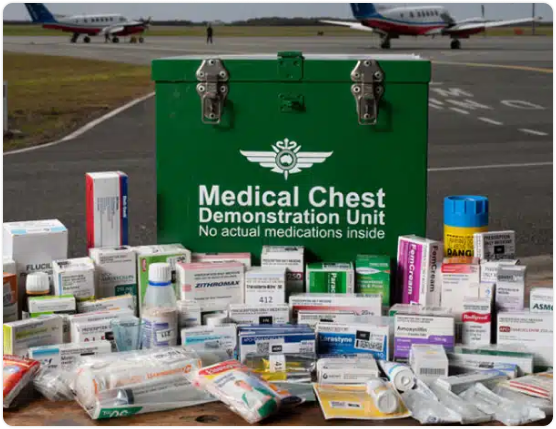
6
Life-saving medical chests for a remote, rural or regional community.

6
Defibrillator Pads – used with a machine to monitor a patient’s cardiac health.
TOP DONATION

Here's how much Kirsty has raised
to keep the Flying Doctor flying!
Kirsty has raised a grand total of $1,234 over 2 years!
Thank you to my supporters
100% Total Legends

Megan Sharp
$108.89
Top Fans
Meg Laverty
$72.06
Vicki and Ashley Knapp
$65
Juanita Stafford
$55.95
Ashleigh Webb
$55.95
Proud Supporters


